
Search intent
Understand what the searcher is actually trying to accomplish.
AI SEO software
LUUMERA connects automated SEO content creation with prioritized SEO opportunities in one automated SEO workflow. It researches search intent and the competitive landscape, builds content briefs and structure, then writes new drafts or rewrites and improves existing content with relevant on-page SEO requirements and internal links. By connecting content production, publishing, and search performance measurement, SEO content automation helps your team move from a validated opportunity to optimized, publish-ready content and ongoing improvement for organic growth.
The problem
Generating text is the easy part.
The real SEO content workflow starts earlier and ends later: choosing the right opportunity, understanding search intent, researching what already ranks, structuring the page, applying SEO requirements, linking it into the site, publishing it, and measuring what happens next.
LUUMERA treats content creation as one execution workflow inside SEO automation, not as a standalone AI writing tool.
Starts from a decision
LUUMERA does not begin content production from a blank prompt.
The workflow starts from an opportunity that has already been evaluated against search demand, competitor evidence, existing site coverage, business relevance, and current SEO priorities.
That means content is created because the site has a reason to need it, not because someone needed another article for the calendar.
Discovery and prioritization happen upstream in Automated Content Gap Analysis and Automated Competitor Gap Analysis. This workflow executes the opportunity they approve.
Research before writing
Before producing content, LUUMERA gathers the evidence needed to understand what the page needs to accomplish.
Understand what the searcher is actually trying to accomplish.
See what currently ranks and which formats dominate the results.
Understand which subtopics competitors cover and where their approaches overlap.
Avoid duplicating pages or competing with content you already have.
Identify existing pages that should connect to the new content.
From research to a plan
The goal is not to copy the SERP.
It is to understand the structure, questions, coverage, and intent the page needs to address while keeping the content aligned with the business.
Built around the business
Generic AI content often sounds generic because the model knows the keyword but not the company.
LUUMERA uses the site’s business context, products, audience, positioning, markets, existing pages, and SEO evidence when creating content.
Search relevance matters, but the page still needs to sound like it belongs to the business publishing it.
On-page SEO
Writing the article is not the end of the job.
The surrounding on-page elements determine how the page fits into the site’s search structure and how clearly its topic is communicated.
LUUMERA prepares and recommends these elements as part of content execution rather than leaving on-page SEO as a separate manual pass.
Internal linking
New SEO content should enter the site already connected to relevant existing pages.
LUUMERA can use the existing content map to identify pages the new content should reference and relevant places where existing content could link back to it.
Content becomes part of the site structure rather than an isolated URL.
From draft to publication
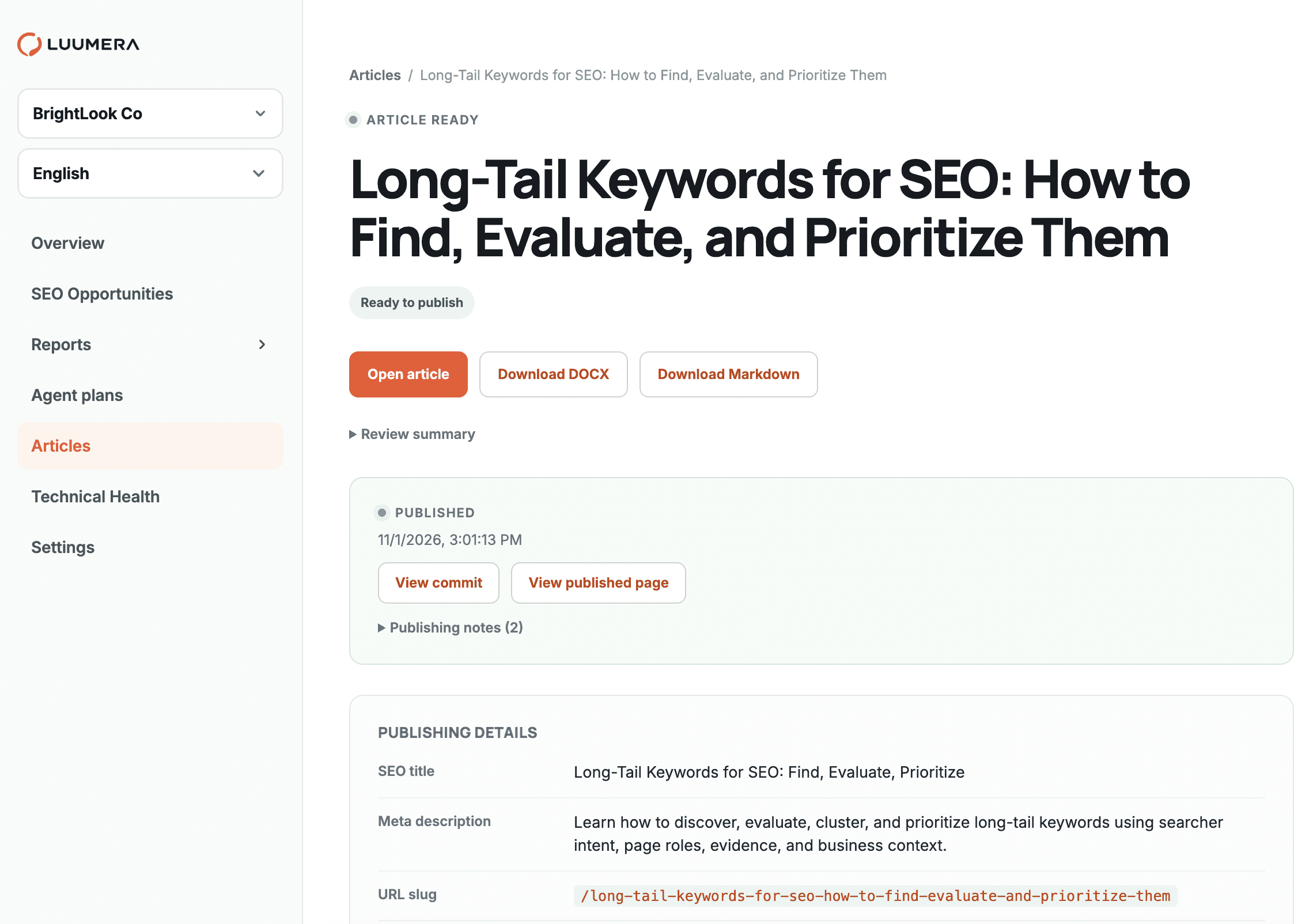
Once the content is ready, LUUMERA turns the result into a publishable artifact instead of stopping at generated text.
Content moves through review states before it goes live, and where it is supported, GitHub-based publication can take an approved page from draft to a live page.
After publication
Once a page is live, new search evidence can show whether the opportunity is actually producing results.
LUUMERA can use ranking and Search Console evidence to understand whether the page starts gaining impressions, rankings, and clicks, or whether it needs further improvement.
Inside LUUMERA
SEO Content Automation is the execution layer.
Other LUUMERA workflows help discover and prioritize opportunities. Once a content action is selected, the content automation workflow turns that decision into finished work.
SEO Competitor Intelligence and Automated Content Gap Analysis surface and prioritize opportunities — with Automated Competitor Gap Analysis adding competitive evidence — and this workflow executes the ones that are approved, all inside the broader SEO automation system.
The difference
An AI writer starts with a prompt and produces text.
SEO content automation starts with a validated opportunity and ends with content integrated into an SEO workflow.
The difference is not better text generation. It is automating the workflow around the text.
One execution workflow
Start from a prioritized, validated SEO opportunity.
Gather search intent, SERP, competitor, and site evidence.
Turn research into a structured content brief.
Create content using business context, not the keyword alone.
Prepare titles, metadata, headings, and topic coverage.
Identify how the page connects into the existing site.
Produce a publish-ready artifact and move it through review.
Use ranking and Search Console evidence to decide what is next.
Who it is for
Turn product, use-case, comparison, integration, and educational opportunities into publishable SEO content.
Keep content production moving without manually managing research, briefs, drafts, optimization, and publishing.
Reduce the operational work around SEO content production while keeping execution tied to real opportunities.
Automate execution while keeping content connected to prioritization, search evidence, and the broader SEO system.
LUUMERA connects SEO prioritization with content execution, so strong opportunities can move from research to publication instead of becoming another item in the backlog.
Analyze my website